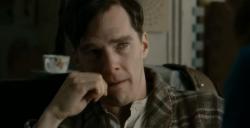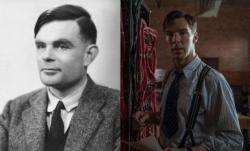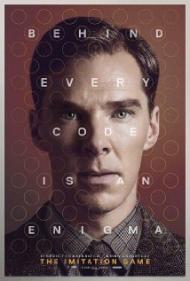



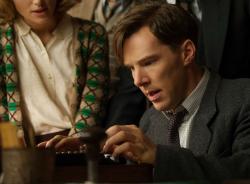
This year's crop of leading actor award contenders just got a new front runner with Benedict Cumberbatch in the role of Alan Turing in The Imitation Game. It's a heartfelt and emotional performance that highlights the wartime career of Alan Turing, the man who Winston Churchill credited with doing more to win World War II than any other single individual.
The story is told at three different times in Turing's life. The main part of the story takes place during the war when mathematician Turing takes a job at Bletchley Park, the former radio factory that was used for the course of the war as the top secret home of the British codebreakers. Turing, who is portrayed as socially awkward as he is intelligent, rubs every member of his team the wrong way while building one of the world's first computers to crack the German Enigma machine. He is helped with his socializing skills by Joan Clarke (Knightley), the only female member of the team, who he befriends and eventually becomes engaged to in order for her to remain on the project.
We also see Turing as a child in the 1920s when he develops a crush on a male childhood friend. And we see Turing in the early 1950s when he is being investigated by the police as both a suspected Soviet spy and a homosexual, which was a punishable crime in the UK until 1967. Although the ending and Turing's fate is a matter of historical record, I won't give away the details here in case you are unfamiliar. I'll only say that it's a tragic ending and a shameful moment in history.
While the script is based on facts, they have been given the Hollywood treatment. In a way this is understandable. If the script remained true to just the facts it would be a dry movie about mathematicians and engineers that would only be of interest to other mathematicians and engineers. And so Joan's relationship to Alan is made more dramatic and her character is given a touch of glamour with the casting of Knightley. Tension is created between Turing and his superiors that leads to the Hollywood moment shown in the previews where Turing is threatened with being fired until his team steps in to say that if Turing goes, they go.
Perhaps the most disappointing aspect of the script is that while Turing is persecuted in the film for being gay, it shies away from actually showing him that way. The flashback to his childhood is kept perfectly chaste and in 1951 Alan mentions a homosexual act, but he is portrayed for the majority of the film as nearly asexual. I'm not suggesting we needed to see him engaged in sex, but it's notable that a film that condemns the treatment of homosexuals is so delicate about showing its lead as one. Instead, it plays it all quite safe by having Turing admit to being gay, but without ever showing him in a romantic or sexual situation with another man.
Whatever the film's flaws are however, they are more than made up for by Cumberbatch's performance. Although he's played a genius sociopath for a few years as TV's Sherlock Holmes, he rarely gets to show much emotion in that character. Here however, we see the cracks in the facade, culminating in his final scene, which might just be the moment that wins him his Oscar. Even before that moment though, he's quite brilliant as the quirky genius with a plethora of tics.
One of the most refreshing things about this Oscar buzz worthy film is that unlike so many such films, this one is actually entertaining. Sure, it's easy to see Hollywood through the history, but at least the gist of the story is true and it's about time Turing and his team received their due. And come Oscar time, Cumberbatch might too.