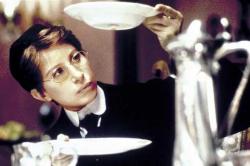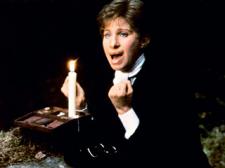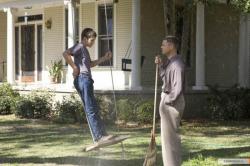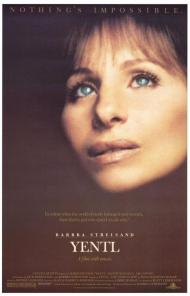



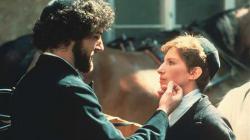
Consider first that Barbra Streisand is in every scene except one. Consider also that she sings every song in this musical. She also directed and produced this movie. In other words, it greatly helps to be a Streisand fan when watching this, nearly, one-woman show.
Yentl is a Jewish girl who secretly studies the Talmud. Her single father allows her to read and study it in the privacy of their home, with the curtains closed. He believes God will understand but he is not so sure about the neighbors. At the turn of the century in Lithuania, Jewish women were not allowed to study religion. In one of the first scenes a peddler calls out "Religious books for men. Picture books for women." Upon the death of her father, Yentl cuts her hair and dresses as a man in order to attend an all-male Yeshiva to study the Talmud.
Although well into her adult years, Yentl is still naive to the world and ways of men and because of this, many humorous events befall her. In one scene she has to share a bed with a classmate, Avigdor, who doesn't know she is a girl. She keeps falling out of the bed in an effort to keep their bodies from touching under the covers. In another scene she gets dragged along to a swimming hole where all the other Yeshiva students are going skinny-dipping.
Yentl soon finds herself falling in love with Avigdor, who is engaged to Hadass, a traditional girl who is more studied in domestic arts and flirtation than religion or philosophy. Things get even more complicated when Avigdor is forced out of his engagement to Hadass. Yentl, now called Anshel, steps in as the new groom in order to make Avigdor happy and stay close to him.
Although Anshel is able to fool Hadass on the wedding night, in a very humorous scene, the stress of the charade becomes too much for the girl in disguise and she decides to tell Avigdor the truth. In the privacy of a hotel room, Yentl bares her soul as well as her breasts. For about 15 seconds, Yentl's dream is a reality. After some yelling, Avigdor accepts Yentl for what she is, and imagines a possible future together but then he explains how she will have to hide her studies. Yentl realizes she can never have the life she wants with Avigdor as he is as much a victim of his time as she is.
That scene is the best dramatic moment in the film. Streisand goes from being nervous to excited to disappointed to understanding in a matter of minutes. The movie contains several great scenes and moments but at 132 minutes there was room for trimming. After all, this movie is based on a short story, by Isaac Bashevis Singer.
The early moments with her father were nice enough, but they could have been covered much quicker. The song, "Where Is It Written?" should have been played over the opening credits, interspersed with an old Yenta making fun of Yentl's age and Yentl's father telling her to close the curtains. As soon as the song ends the movie could have opened on her father's funeral. Someone could have said they heard that old maid Yentl was secretly, and shamefully, studying Talmud. Then skip to her dressed as a man walking down the road. That alone would have cut at least 15 minutes. And all of the needed plot exposition would have still been explained.
There are plenty of songs in this movie and all are excellently appropriate. They all invoke the emotions and opinions of Yentl. Many of these songs, written by Alan and Marilyn Bergman, are often quite philosophical. I think that this line from "A Piece of Sky" is brilliant: "The more I learn, the more I realize, the less I know." I once used it in a college philosophy paper.
Barbra Streisand put everything she had into making this movie and it shows. The details and the emotions of the film are all evidence of that. However, Streisand forgot the old adage that less is sometimes more. She told in interviews that this film brought up much interest in her faith and her father. Perhaps she was too close to the material to keep it at an enjoyable length.