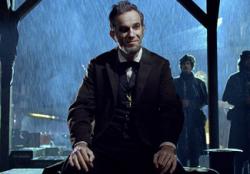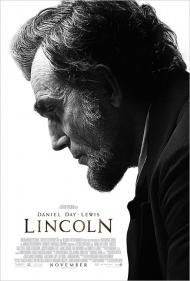



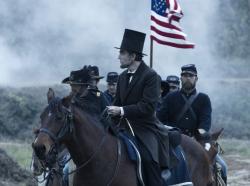
Two years ago in my review for The King's Speech I correctly predicted it would win Oscars for Picture, Actor and Screenplay. I'm going to make the same prediction this year about Lincoln. And on top of those three awards I predict wins for Supporting Actor/Actress for Tommy Lee Jones and Sally Field respectively. Not only is Lincoln a damn good movie but it has all the qualities that Academy voters have long rewarded in films. It's about America's most revered President and it deals with one of the most historically pivotal periods in our countries' history. But then when you have Steven Spielberg directing Daniel Day-Lewis as Abe Lincoln, you're already halfway to the podium come Oscar night.
Set during the closing months of the American Civil War, Lincoln shows the behind the scenes due process (scrambling for votes by means ranging from sublimely compelling arguments to old-fashioned bribery) needed for ratification of the Thirteenth Amendment which outlawed slavery in the United States. Lincoln is in a race to get it passed before peace is declared, as the ending of the war would leave the Amendment dead on the House floor.
Spielberg's incredible storytelling talents are put to good use. The subject matter isn't all that cinematically exciting but the way it unfolds is compelling. Even though we all know how the story ends there is a real sense of tension and urgency to it. And fortunately Spielberg never allows any cloying sentimentality to overpower the movie like he did with last year's overrated War Horse.
Visually Lincoln impresses. It transports the viewer back to our nation's capitol in that fateful winter and early spring of 1865. The sets and costumes are meticulously authentic looking. There is one scene near the end where we watch Lincoln's silhouette, wearing his trademark stovepipe hat as he walks away from the camera towards the door of the White House. It's a powerful image and one of those screen moments destined to become indelible in our collective movie-going consciousness.
President Woodrow Wilson famously waxed poetic after watching D.W. Griffith's The Birth of a Nation. He said it was like “writing history with lightning.” The same can be said of Lincoln. It demonstrates the power of film in bringing history to life in a way no other art form can.
And now for the cast. Everyone in the movie is terrific. David Strathairn, Tommy Lee Jones and Sally Field are all at the top of their games.
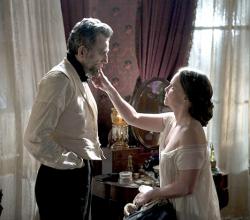
Field makes Mary Todd Lincoln a real person and not merely the spendthrift/bi-polar caricature she is usually made out to be. Her part is rather small but she makes the most of it, particularly during a heated argument with her husband.
Jones imbues Thaddeus Stevens with an implacable moral authority representing the soul of the abolitionist movement. The radical republican Congressman who was leader of the powerful House Ways and Means Committee provides the movie with a bit of levity as well as the one big surprise in the story.
Strathairn plays Secretary of State (and Lincoln's closest and most trusted confidante) William Seward with the intense conviction the part calls for.
But every other performance pales in comparison to Daniel Day-Lewis's as the sixteenth President of the United States, Abraham Lincoln. He doesn't seem to be acting at all. It's almost as if he truly believes he IS Abraham Lincoln. And with his well-known penchant for method acting and staying in character even off the set, that might just be true. In a clever move by the director we hear his thin, nasally, high-pitched speaking voice before we seem him. At first we don't realize it's the President that two black soldiers are talking to. Then the camera pulls back to reveal the unmistakable countenance of our most iconic leader.
Steven Spielberg has always been the heir apparent to Frank Capra and Lincoln is the best movie made about the inner-workings of our government since Mr. Smith goes to Washington. And unlike that film this one tells a true story. Secretary of War Edwin Stanton famously said upon Lincoln's death, “Now he belongs to the ages.” The same is true of this movie.