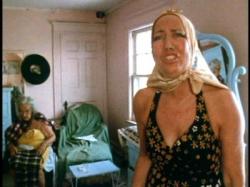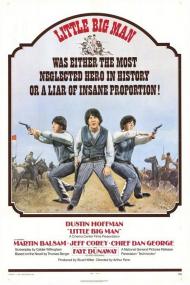



Little Big Man was one of my favorite movies as a kid. I enjoyed the humor and Dustin Hoffman's performance. I even went through a minor Western phase for a while after watching it, but the 1970s were the decade that killed the Western and so it didn't last long.
It was also one of the movies that taught me that when a movie is based on a book, the movie is always going to be inferior. As much as I enjoyed the movie, the book was a true classic. A recent rereading of it proved to me that it really is an American classic and it also lead to a rewatching of the film, which, sadly, hasn't aged as well as the book, being dated, not by its Western setting, but by its 1970s revisionist attitudes.
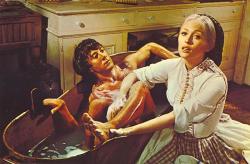
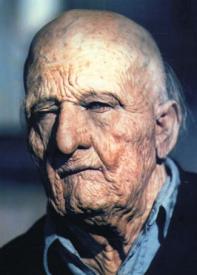
Hoffman plays Jack Crabb, a 111 year old survivor of the Battle of Little Big Horn. He narrates the story of his life up until the fateful battle. His family's wagon train is attacked when he was just a boy and through a misunderstanding is adopted by a Cheyenne tribe. After five years with them, he is taken back into the white man's world where as he grows up he experiences nearly all aspects of Western life, with the occasional return to his Indian family. He encounters General Custer as both an Indian and a white man, eventually accompanying Custer to his infamous last stand.
I could write an entire review that just compared the many differences between the book and the movie, but I won't. I'll just say that the book, while still comical, is much more serious in tone and in theme. It is also, much, much more subtle in its message. In the book, Jack is very much a 19th century Forrest Gump, appearing at many historical events and meeting several very famous Western personages, like Custer, Hickock, Earp and Carson. In the film, Jack knows Custer and briefly meets Hickock, but that's about it, apart from a glimpse of Buffalo Bill. The theme of the book is similar to Huckleberry Finn, in that Jack learns to love and respect, against all of his instinct and upbringing, the Indians, in much the same way that Huck learned to love Jim. The theme of the movie is basically, White Men bad and Indians good and this theme is delivered with a sledge hammer. It's obviously influenced by the era and the Vietnam War and it's not afraid to alter historical facts and incidents to make this point.
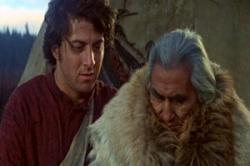
When the movie is played for laughs it is at its best. Jack's brief tenure as a gunfighter is probably the film's funniest portion. Its most successful dramatic moment comes during the Battle of the Washita River when Custer attacks the Indian Village where Jack is living. It's one of the best and most emotional scenes in the film, combining humor as Jack tries to lead his blind Indian Grandfather out of the village and drama as we watch Jack's Indian wife and baby try to escape from the soldiers. The tension of the scene is only undercut by the fact that historically the film gets several things wrong in its efforts to make the military look like butchers and Custer a psychopath.
Reportedly the part of Old Lodge Skins (Jack's Indian Grandfather) was offered to both Marlon Brando and Laurence Olivier, but both turned it down, which is lucky for the film and for Chief Dan George who eventually got the part and a well deserved Oscar Nomination for it. He steals most of the scenes he's in and brings a sense of authenticity to the role that really helps sell the film in a way that having a Caucasian actor in the part wouldn't have done.
While it didn't live up to my childhood memory of it, I did still enjoy Little Big Man. Hoffman is terrific in the lead and the humor still stands the test of time. It certainly never approaches the level of the book however, which deserves far more recognition than it has received.