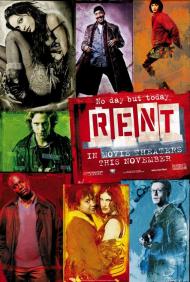




The Broadway version of Rent opened in 1996 and it should have been the musical that dragged Broadway into the 21st century. Although it would go on to win the 1996 Tony Award as Best Musical, 1996 New York Drama Critics' Circle Award as Best Musical, the Drama Desk Award as Outstanding Musical, the Outer Critics Circle Award and three Obie Awards, the tragic death of its creator Jonathan Larson, just hours before the original version of the show debuted Off-Broadway, ended the revolution of "modern" musicals that this show promised to bring. Now, almost ten years after it premiered on the stage, a movie version, featuring all but two members of the original cast, is being released.
Inspired by Puccini's opera, "La Boheme", but updated to New York City's East Village, circa 1989, Rent tells of a year in the life of a group of friends, detailing their loves and losses. And like an opera, the staged version is completely devoid of spoken dialogue. Everything is in song. For the movie version, dialogue has been added, mostly rearranged lyrics from the original that have been adapted to sound better when spoken, but it is still 90% told through song.
The group of friends include Mark; a wannabe filmmaker who documents the year and is the heart of the story, his roommate Roger; a musician suffering from AIDS as the result of a drug habit that he shared with a now-dead girlfriend, Tom Collins; a former roommate of Mark and Roger's who is freshly returned to New York after being fired from MIT, Angel; Collins' cross-dressing boyfriend who is also suffering from AIDS, Benny; another former roommate who married rich and now owns the building in which Mark and Roger live, Maureen; Mark's ex-girlfriend who left him for Joanne; a lawyer, and Mimi; a stripper and another AIDS sufferer who falls in love with Roger.
Conflict in the story is provided by Benny, who plans to tear down several buildings in the East Village and build a Cyber-Studio in their place. Maureen stages a protest, in part because the destruction of the building will mean that she loses her performance space, and Benny tries to arrange for Mark and Roger to convince her to stop her protest by promising them that they can stay in his building for free if they stop her. If they can't convince her, then he demands that they pay him the entire last year's rent, which he let slide out of friendship.
Perhaps the best decision by director Chris Columbus was to bring back the original Broadway Cast. The only two exceptions are Rosario Dawson as Mimi, and Tracie Thoms as Joanne. No one knows these characters better and despite being ten years older, the roles still fit them perfectly.
Before seeing it, Columbus would have been the last director I ever would have picked to direct this movie. I mean, the director of Home Alone doing Rent?!?! The thought is horrifying. I must humbly apologize for the presumption as Columbus does a fantastic job. His most adult film to date, it retains all of the original elements of the play and adds to them. So many stage-to-screen translations are really just filmed versions of the play (see the upcoming The Producers), whereas with Rent, Columbus has transformed the locations and the action so that they are truly cinematic. Mark's fantasy during the "Tango Maureen" number and Collins and Angel's choreography on the subway during "Santa Fe" are two good examples.
My one complaint is the addition to the film of the commitment ceremony between Maureen and Joanne. Not only is it wrong for the time period, but for a group of people who pride themselves on their Bohemian lifestyle to do something that so smacks of respectability is completely out of character.
I've seen the stage version of Rent twice now. Once here on Broadway, and once a few years back in Kalamazoo, Michigan. In Midwest American Kalamazoo, nearly a quarter of the audience walked out during the intermission. The question is, when the movie rolls out, will that same audience and others like it, walk out or remain til the end credits?