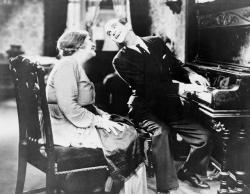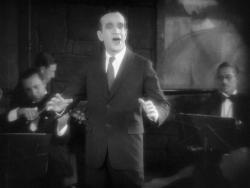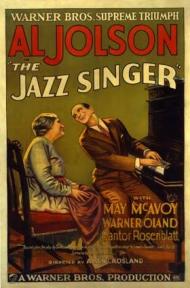



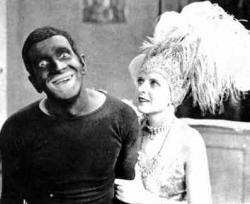
As the movie that launched the sound era, The Jazz Singer is one of the most historically important films in Hollywood history. As entertainment, however, it is nearly unwatchable today. And despite its reputation it's not really a talkie at all. It's pretty much a silent movie, complete with title cards for dialogue, except for the musical numbers, which must have thrilled audiences of the day. Jolson speaks a few lines of in between song patter – most famously when he exclaims, “Wait a minute, wait a minute, you ain't heard nothin' yet!” The only actual conversation occurs between Jack and his mother while he tickles the ivories at the piano in his parent's apartment.
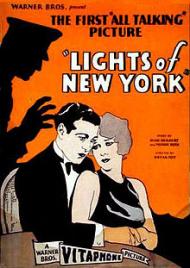
Before The Jazz Singer there had been several talkie shorts and a few features with synchronized sound. D.W. Griffith's Dream Street had featured a single singing sequence way back in 1921. It was the combination of Jolson's popularity and his style of music - which was the rock n roll of its day - that caused audiences to clamor for more sound movies after October 6, 1927. Although it would take Hollywood's movie studios, and theaters across the country, months to make the switch to sound. For the record the very first all talking feature, Lights of New York, wasn't released until July of 1928. And it wasn't until 1930 that the transition to sound would be complete, with only Charlie Chaplin remaining as the last hold-out from the silent era.
Although he's primarily remembered today for this movie, during the early decades of the 20th Century Al Jolson was the highest paid and most famous entertainer in America. As the first performer to conquer the stage, recordings, the movies and radio, he was the first true superstar. Jolson was 41 when this movie was made; he had been a star since his first sell-out engagement at the Winter Garden in 1911.
Unfortunately his singing style and song choices (you just don't hear “Toot Toot Tootsie” and “Dirty Hands, Dirty Face” being sung anymore) seem hopelessly old-fashioned and corny today. His exaggerated emotionalism is maudlin enough but when he dons blackface to sing “My Mammy” it's positively cringe inducing.
The plot is creaky melodrama. 13-year-old Jakie Rabinowitz, the son of a Jewish cantor living on Manhattan's Lower East Side, gets caught singing jazz songs at a local beer hall. After his father severely chastises him he runs away from home. Years later Jakie – now going by Jack Robin – is an up and coming singer in San Francisco. He meets a girl and she helps him get his big break. Jack eventually makes it to Broadway and reconnects with his parents. At the climax Jack must choose between his Broadway debut and singing at the synagogue for his dying father.
Sharp eyed viewers may spot the beautiful Myrna Loy as a chorus girl. Roscoe Karns and William Demarest both show up in small parts as well. With a total of ten songs performed, The Jazz Singer is the first movie musical. It's a unique hybrid, a sort of silent musical, if you will. As historically important as it is though, it's just not a very good movie.